
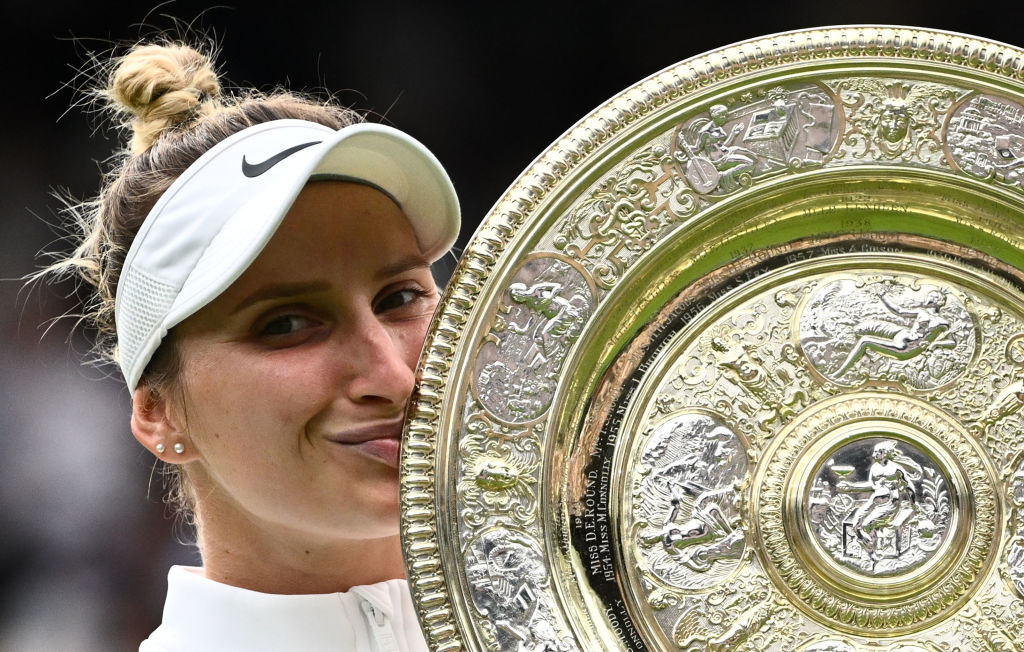
Marketa Vondrousova, the Czech southpaw who in 2023 became the first unseeded Wimbledon women’s singles champion in history, has been suspended for four years after refusing an anti-doping test.
The 26-year-old declined to submit an out-of-competition sample when visited at her home by a doping control officer in December of last year, prompting the International Tennis Integrity Agency (ITIA) to charge her with an anti-doping rule violation in late February.
Writing on social media, Vondrousova attributed the incident to an accumulation of “months of physical and mental stress” that clouded her judgment and meant she “couldn’t process the situation rationally”. She also cited safety concerns.
However, an independent tribunal hearing held earlier this month in London found that Vondrousova provided “no compelling justification” for her refusal to take a test. She must now serve a suspension until 21 June 2030, although she retains the right to lodge an appeal with the court of arbitration for sport.
What did Marketa Vondrousova say about her four-year ban?
“I would not wish what I have been through over the past few months on anyone,” Vondrousova wrote on Instagram. “It has been an incredibly exhausting and painful period that affected me far more deeply than I could have ever imagined.
“I have never doped. I have never had a positive test throughout my entire career. I have undergone countless anti-doping controls and have always stepped on to the court with a clear conscience.
“Professional sport means accepting rules and controls. I’ve always respected them.”
The Czech, who reached the 2019 French Open final as a teenager and won a silver medal at the Tokyo Olympics two years later, has a career-high ranking of sixth. She is currently ranked 122 in the world, having not played since withdrawing from the Adelaide International in January with a shoulder injury.
“I honestly do not know what comes next,” Vondrousova added. “For the first time in my life, I do not have a plan.”
A host of senior WTA players including Sorana Cirstea, Paula Badosa, Coco Gauff and Ons Jabeur responded to the former Wimbledon champion’s post with expressions of support.
What did the International Tennis Integrity Agency say about Vondrousova’s ban?
Karen Moorhouse, the ITIA chief executive, acknowledged the severity of the punishment but said treating refused tests with the same rigour as proven anti-doping violations was the only way to uphold the effectiveness of the wider system.
“We recognise that this is a significant ban,” said Moorhouse. “The reason for that is that you can’t have an anti-doping system where a player is in a better place by refusing to take a test than they would by taking the test and testing positive.
“That feeds into the structure of the doping rules that provides for a starting point of a four-year ban for refusing to take a test, the same as a starting point for testing positive.”
Moorhouse hailed the tribunal verdict as an endorsement of the importance of random testing in maintaining the sport’s integrity.
While the doping control officer who visited Vondrousova did so outside the daily one-hour slot when players are obliged to make themselves available at a specific location, the rules also allow for occasional unscheduled testing.
“Unpredictable testing is an essential tool to protect clean sport,” said Moorhouse. “The independent tribunal ultimately supported that principle. The case is an important reminder that players can be tested at any time, in any place, and that refusal comes with significant risk.”
What happened when Vondrousova was visited by a doping control officer?
At about 8pm on 3 December 2025, a female doping control officer arrived unannounced at Vondrousova’s home to conduct an out-of-competition test. According to Nicole Sapstead, the ITIA’s senior director for anti-doping, the Czech refused to admit the officer, instead signing a refusal form as she left her apartment with her dog.
“The player signed the refusal form outside,” said Sapstead. “She left her apartment to walk her dog and made it clear to the doping control officer that she was refusing a test. The doping control officer asked her to sign the form to indicate as much.
“We ask our doping control officers to be as clear as possible when they’re engaging with players. It’s not for them to tell a player where a sanction may lay.
“What we do say is: ‘Please make it very clear that there are consequences, some significant consequences, if that individual refuses.’ So yes, that was made very clear to the player. It was very clear that the player did not wish to engage with the process.”
Vondrousova later said on social media that her refusal to co-operate stemmed from concerns about her personal safety resulting from the officer’s alleged failure to provide the appropriate credentials and authorisation. She said experts had confirmed that she suffered an “acute stress reaction and generalised anxiety disorder”.
“The doping control incident happened because I reached a breaking point after months of physical and mental stress,” Vondrousova wrote in April. “When someone rang my door late at night without properly identifying themselves or following protocol – I reacted as a person who felt scared.
“In that moment it was about feeling safe, not about avoiding anything. Fear clouded my judgment and I just couldn’t process the situation rationally.”
‘We don’t take strangers at our door lightly’
In the same post, Vondrousova also alluded to the knife attack suffered by her compatriot Petra Kvitova when an intruder broke into her home in Prague in 2016. The double Wimbledon champion was forced to undergo surgery following the incident, in which she suffered potentially career-threatening injuries to her left hand. Kvitova made a successful return to competition six months later.
“After what happened to Petra, we don’t take strangers at our door lightly,” said Vondrousova.
The Czech’s account of her actions has fallen on deaf ears, however, and only a successful appeal can now save what should be her peak years in the sport.
Vondrousova’s camp have indicated that they will await publication of the full written judgment before deciding on next steps.