
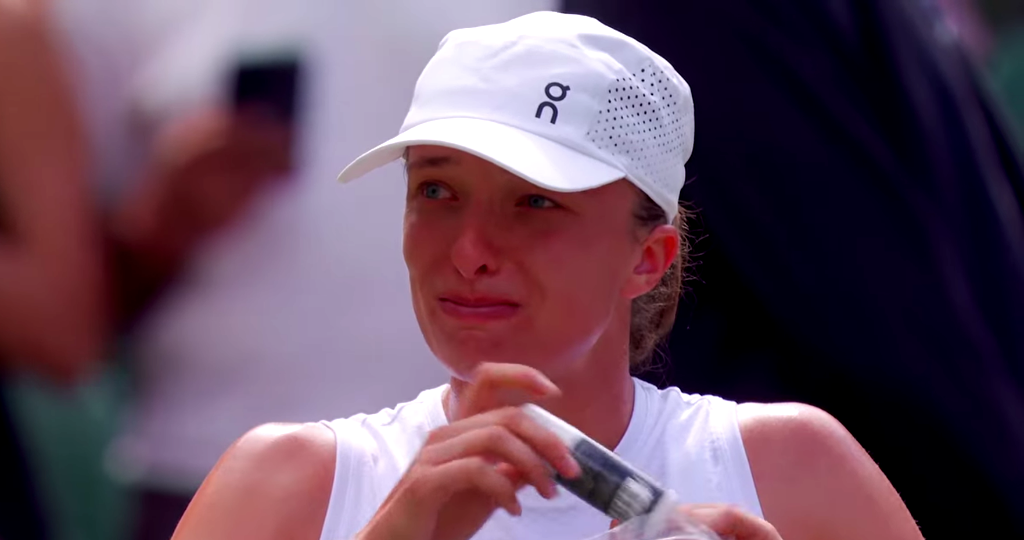
A self-confessed introvert, Iga Swatek does not relish being the focus of attention.
As the defending Wimbledon champion, however, that is the role in which the 25-year-old has been cast since her arrival in SW19 last week, and she has appeared faintly bemused by the attendant pageantry. Perhaps that is partly because Swiatek, a player better known for her exploits on clay, always regarded the prospect of winning on the lush lawns of the All England Club as “impossible”. It is hard to be fully prepared for something you never envisaged happening in the first place.
Happen it did, however, and having beaten Amanda Anisimova to win the title last summer, it fell to Swiatek to open the Centre Court programme on the first Tuesday, as tradition dictates the returning champion must.
On the eve of the fortnight, Swiatek spoke of keeping her expectations low – as well she might, after a chequered season in which she has slipped to third in the rankings, lost an opening round match for the first time in 74 outings in Miami, and failed to win a title. Yet, with the sense of occasion underlined by the presence of her father and sister in the Royal Box, there was no prospect of going under the radar as she faced American doubles specialist Taylor Townsend.
An unkind draw may yet pit her against more illustrious names, but Townsend represented an undeniably tricky opening assignment. The 30-year-old’s modest singles ranking of 79th belies her pedigree and skills – she is No 2 in doubles, where she is a three-time major winner – and the suspicion was that she would would provide a stern early test for the Polish third seed. So it proved.
How Iga Swiatek narrowly avoided an unwanted record
For two hours and two minutes, momentum flitted back and forth and Swiatek frequently seemed closer to disaster than triumph. Defeat would have earned the Pole the dubious distinction of joining Steffi Graf and the suspended Marketa Vondrousova as only the third defending champion in the open era to lose in round one. Little wonder, then, that her 6-1, 2-6, 6-3 victory exacted an emotional toll that was plain to see as she sat weeping into a towel afterwards.
“For sure it’s not easy to come back as a defending champion, so I’m happy that I got through the match,” said Swiatek, who began the afternoon in near-immaculate fashion only to end it with 36 unforced errors, including nine double faults.
“I think the whole process of opening on [Centre Court] and playing as the defending champion is for sure really emotional. Last year, probably the most amazing thing in my whole tennis career happened here, so I felt it also today. It was a mix of different emotions. Overall, I’m happy that I got to win and I can have another chance to play on this court.”
That opportunity will come against Czech former finalist Karolina Pliskova, but at times it was touch and go. Swiatek admitted in her on-court interview that nerves got the better of her in the second set, but expressed satisfaction that she was able to recover her game in the decider.
“These are the moments that you feel you did the job,” she said, “because it is not hard when everything goes your way and you are so confident that everything goes in.”
How did Taylor Townsend run Iga Swiatek so close?
Townsend’s assertive approach to the contest limited Swiatek’s ability to establish that confidence. Time is at a premium on a grass court, and it was clearly the American’s intention to ensure her opponent enjoyed as little of it as possible. It is no secret that the Pole can be vulnerable from the back of the court when rushed, and Townsend’s tactic of adopting a highly aggressive return position, often a foot or more inside the baseline, served to maximise the champion’s discomfiture.
Smoking her returns, Townsend fashioned five break points in Swiatek’s opening service game. The world No 3 saved them all and, having held from 15-40, went on to snatch a break of her own. Another soon followed, Swiatek forcing a volleying error with a dipping return. With barely half an hour played she was, emphatically, on her way.
At a set down, Townsend faced a tactical puzzle. She had the makings of an effective strategy, but unforced errors – 11 in the first set, versus a miserly four from Swiatek – were making it hard to implement. It did not help that she was landing a relatively modest 60% of her first serves at that stage, limiting her ability to play the match from the net, and therefore on her own terms. Invited to make hay on the return, Swiatek accepted the gift gleefully, limiting the American to a meagre 30% of points behind her second delivery.
With the tactical clarity of Townsend’s early efforts becoming a distant memory, the dawn of a new set brought a chance to reset. This time, she executed her game plan to perfection. Nailing a return to force a Swiatek error, Townsend broke in the first game. That fed her conviction and, committed once more to a front-foot approach, she soon began to showcase her proficiency at the net, picking off volleys behind knifed approach shots. As Townsend attacked with aplomb and defended with newfound resilience, it was Swiatek’s turn to wobble.
The numbers behind Iga Swiatek’s second-set dropoff
The numbers reflected the extent of the turnaround. Having won six of 13 net points in the first set, Townsend claimed 13 of 16 in the second. Her seven unforced errors were fewer than half Swiatek’s 16, while her success rate behind the second serve soared to an impressive 70%. By the time Swiatek left the court for a comfort break with the match level, it was the champion who had all the thinking to do. Her analysis made for fascinating listening.
“I felt that at the beginning of the second set, Taylor kind of pushed a little harder, she went to the net more successfully, compared to some volleys she missed in the first set.,” said Swiatek. “There are always two people playing, you know; if she didn’t push, then maybe I wouldn’t make these mistakes.
“I felt like at the end of the second set it was a more even game – it’s not like I was playing stupid – so I had something to be positive about. I went into the third set knowing that now we start from the beginning.”
And what a beginning it was.
For 21 minutes the players toiled, Swiatek alternately shooting herself in the foot with double faults, of which she produced three, before training her sights on Townsend. The absorbing battle of wills, a mirror of Swiatek’s first service game of the afternoon, eventually went her way – although not before she had staved off four break points, one of them with a meaty 104mph second serve.
It was a vital breakthrough. Swiatek won her next two service games to love and, although she was dismayed when Townsend cancelled out a break midway through the set, she broke again in the eighth game with a lovely rolled pass. She would not be caught again, sealing victory with her second ace of the day.
Having met the demands of the occasion, Swiatek will no doubt be grateful to relinquish the spotlight.
“You feel like a lot of people are waiting for this match, like it’s all coming up to have this moment on this court, which feels strange because it’s just a tennis match,” said Swiatek.
“But that’s what Wimbledon is about a little bit, and I really wanted everyone to enjoy it – and I wanted to enjoy it, which is obviously not easy, because playing tennis is sometimes tough.”
Whatever unfolds over the next fortnight, Swiatek will have few days tougher than this.