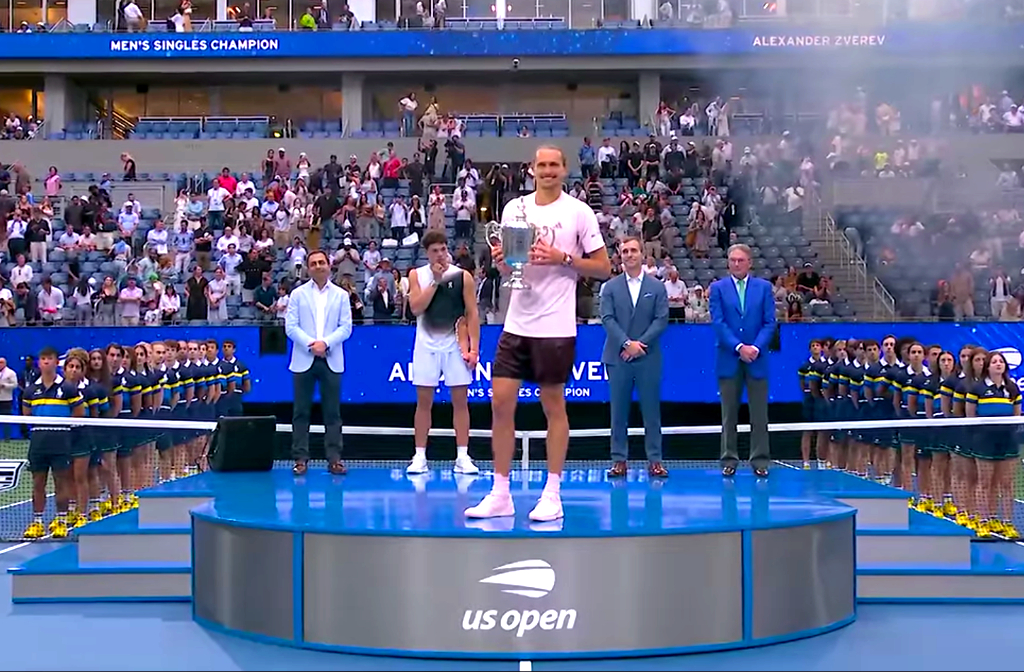
Alexander Zverev has spent so long striving for grand slam success that, even with the US Open title won, he remained steadfastly focused on the process rather than the outcome.
Never mind that the 29-year-old German had just converted his first championship point with a 137mph serve. Never mind that the chair umpire had declared the match his, or that a crestfallen Ben Shelton was trudging disconsolately to the net for the handshake. Zverev passed the ball in his pocket to the opposite end and prepared to return serve. He was ready for more.
Zverev would later offer various explanations. He said he had forgotten the score, that he was too dialled in to register what was going on around him. He claimed the din of the crowd had drowned out the umpire’s announcement that the match was done. Tellingly, though, he also said he heard nothing.
“In that moment, I was in the zone,” Zverev, the top seed, remarked after defeating Shelton, the eighth. “I didn’t hear noise at all. I was in this kind of tunnel where I just didn’t hear anything.”
In a sense, Zverev has always been there. He has had to be. The alternative, after losing his first three major finals, would have been to heed the voices – not least, perhaps, the one inside his own head – that questioned whether he would ever become a grand slam champion.
That debate was laid to rest when Zverev won Roland Garros this summer. But maybe the mantle of perennial contender is harder to shake off – and maybe that did Zverev a favour. He acknowledged afterwards that not knowing he was serving for the title had helped. Closing out a match from a winning position, when nerves are at their most taut and an opponent with nothing left to lose starts swinging more freely, is rarely straightforward.
Zverev knows that as well as anyone. At the 2020 US Open, in an Arthur Ashe Stadium emptied of spectators by the global pandemic, he served for the title against Austria’s Dominic Thiem only to falter two points from victory. The tears he wept afterwards set the tone for much that would follow, at least until this season. The despair of that defeat haunted him, yet it also fuelled a resolve to do better. He has been fighting ever since, and it seemed oddly appropriate that, even with the last ball of the US Open final struck, his first instinct was to keep battling.
How Ben Shelton breathed new life into the American dream
Now it is Shelton’s turn.
Zverev’s maiden US Open title laid waste to the American dream of crowning a first homegrown men’s champion since 2003, when Andy Roddick won at Flushing Meadows. The prospect of such a drought seemed remote back then, with the exploits of Pete Sampras, Andre Agassi and Jim Courier still fresh in the memory, and the near quarter of a century since has brought much hand-wringing and angst. But in the imposing form of Shelton, there is hope.
The past fortnight has redefined Shelton’s place in the global pecking order. The former University of Florida man had twice before made a major semi-final, first at the 2023 US Open, where Novak Djokovic memorably put the phone down on him, and then at last year’s Australian Open, where Jannik Sinner defeated him in similarly decisive fashion. The impression was of a fine young player, one well worth the top-10 place he secured for the first time last summer, who nonetheless remained a work in progress.
Shelton’s strengths – a ferocious southpaw serve, rubber-limbed athleticism, power and variety off the ground – were always clear. But so too were the deficiencies. He lacked the consistency and focus to hang with the very best from the back of the court, certainly over the long haul of a five-setter. His backhand remained relatively vulnerable. And his return game was not at the level of the best of his contemporaries, which in turn put more pressure on his serve, the bedrock of his game.
Shelton’s epic quarter-final victory over defending champion Carlos Alcaraz showed just how far he has come in addressing those shortcomings. He not only went toe-to-toe with the Spaniard from the baseline, showing hitherto unseen levels of consistency, defensive resilience and sustained quality, but also rode the contest’s momentum shifts beautifully. Shelton remained focused after dropping the opening set, weathered the inevitable Alcaraz fightback, and played with composure – and deep conviction – to recover from 5-3 down in the fifth-set tiebreaker.
Then he did it all over again to take down his compatriot and close friend Frances Tiafoe in the last four.
So this was no flash in the pan, even if some will highlight the absence of the injured Sinner and the fact that Alcaraz, playing his first event since hurting his wrist in mid-April, came into the tournament undercooked. Shelton’s run to the final has propelled him to a career-high ranking of fourth, and on the latest evidence that feels about right. The challenge now will be to remain there, but his ceiling looks high and, at the age of 23, his current trajectory bodes well for the years ahead.
Why Zverev was the wrong opponent for Shelton
But as Shelton contested a major final for the first time, it was his misfortune to face an opponent singularly well-equipped to nullify his main strengths.
Zverev, who spent his formative years sparring with his older brother Mischa, a former world No 25 who plays left-handed, is the scourge of the southpaw fraternity. The German came into the final with just one defeat in his last 45 matches against left-sided players, a statistic that underlines his mastery of the relevant patterns of play. A peerless two-handed backhand, combined with the enormous wingspan afforded by a 6ft 6in frame, enables Zverev to neutralise not only the sliced, outswinging serves to the ad court that traditionally confound right-handers, but also the line-breaking cross-court forehands favoured by Shelton and his ilk.
That reality was reflected in the numbers. While Zverev made 69% of his first serves but won a dominant 85% of those points, Shelton was unable to parlay the exceptional consistency of his first delivery into a more significant statistical advantage. The American made 71% of his first serves – well above the top-10 average of 64% – but could only break even in terms of points won, falling below the 75% average normally achieved by the elite.
No calculator was required to discern the reason for that disparity. Shelton sacrificed speed for consistency. At 119mph, his average first-serve speed was 5mph down on his semi-final win over Tiafoe, and slower than it had been at any stage since his fourth-round win over Stefanos Tsitsipas. Having produced a mighty 20 aces in his semi-final win over Tiafoe, Shelton was limited to half that number against Zverev. The occasion demanded more and yet, against an opponent more capable than most of neutralising his chief weapon, Shelton delivered less.
That was a problem, because rather than winning free points on serve, Shelton opened the door for Zverev to get into baseline exchanges in which the German was able to expose his primary weakness. Shelton’s backhand, though much improved, is at its most effective against pace, which Zverev denied him by peppering that wing with deep, high balls. As Andy Roddick pointed out, the strategy was made possible by the heavy forehands Zverev occasionally sent down the line, which deterred Shelton from running around his forehand.
The cumulative effect was to place intolerable pressure on Shelton, who was guilty of some untimely errors as he attempted to become the first black American to win the title since Arthur Ashe in 1968. The tone was set early. In the opening game of the match, the first of four Shelton double faults over the course of the final yielded an immediate break for Zverev. The second arrived on set point, gifting Zverev the first set. For Shelton, meanwhile, chances were scarce and, when they arose, freighted with tension. He would convert just one of the break points he created.
Even that breakthrough did not come until two hours and 49 minutes into the contest. Nonetheless, as Zverev shanked a high forehand volley to drop the third set, there was a whiff of vulnerability about the German for the first time. The home crowd finally had something tangible to get behind and Shelton, feeding off their energy, began the fourth at a lick, pouncing on a short ball to rifle a backhand winner, then exuberantly celebrating Zverev’s failure to put a second serve return back in court.
It was a delicate moment in the contest, but Zverev has become a master of moments this season. So he was again, working his way back into the game before grinding out a long rally to secure the break. He would make only one more unforced error, completing victory in three hours and 33 minutes – an echo, oddly, of Shelton’s 3.33am finish against Alcaraz. Shelton will not have appreciated the irony.
A complicated victory
As is often the way, the aftermath of a largely underwhelming final was chiefly about the revelation of character. For many, that is where things get complicated.
If Zverev’s failure to notice his victory provoked bemused laughter, not least from the player himself, then his decision to approach Shelton’s team, each member of which received a handshake and a word of congratulation on a job well done, could only prompt admiration. Magnanimity comes easily in victory, of course, and it would be easy to dismiss the gesture as an attempt by Zverev to improve his optics. Yet the warmth and respect he expressed towards Shelton, whom he hailed as “an incredible person and player”, felt genuine enough.
There was empathy, too. When he described his opponent’s run to the final as a “family affair”, Zverev, who has been coached throughout his career by his father Alexander Sr, knew whereof he spoke. It was an acknowledgement of the shaping influence that Bryan Shelton, a former pro with a career-high ranking of 52, has played in his son’s career. A tribute too to the tireless support of his mother Lisa, herself once an accomplished junior player, and his ever-present sister Emma, a former college player turned investment banker. Zverev, who spoke emotionally of his mother Irina’s strength in refusing to allow a childhood diagnosis of Type 1 diabetes to define him, appreciates the importance of family.
There was even a shoutout to Shelton’s girlfriend Trinity Rodman, the Washington Spirit forward, whom Zverev joked was usually a “lucky charm” for her partner. That drew laughter from Rodman, although not everyone saw the funny side. Social media snipers immediately declared the comment disrespectful, suggesting Zverev was mocking her. That seemed a stretch, but public scrutiny has become a way of life for the German.
Zverev has twice been accused of domestic violence, allegations he has consistently denied. Two years ago, he reached an out-of-court settlement with his former partner Brenda Patea, the mother of his child, after she claimed he had physically assaulted her. The Tiergarten district court in Berlin, where a scheduled trial was discontinued in June 2024, made plain at the time that the proceedings had been discontinued without a verdict and that the dismissal did “not constitute a finding of guilt or an admission of guilt”.
Zverev had denied the allegations, just as he did those of Olya Sharypova, another former girlfriend, whose claims were the subject of an independent investigation commissioned by the ATP. The inquiry found insufficient evidence to substantiate Sharypova’s claims.
In the absence of a court verdict on the allegations, people have inevitably formed their own perceptions of Zverev. Some cannot forget, others are eager to move on; many are ambivalent. In other words, he is a divisive figure. Zverev has won two of the four majors this season, and 25 of 27 matches at grand slam level. He may yet claim the year-end No 1 ranking. Yet he continues to languish at the epicentre of a moral maze.
It was never supposed to be this way.
When he won the season-ending ATP Finals in 2018, Zverev was widely seen as the man most likely to shatter the long-running cartel operated by Rafael Nadal, Roger Federer and Novak Djokovic. At the time, that assumption did not seem fanciful. He had gone through Federer and Djokovic in successive rounds to win the ATP Finals, becoming only the fourth man to do so. He possessed a blunderbuss service, a sumptuous backhand, and greater speed and agility than might be expected from a man of his size. The world seemed Zverev’s to conquer.
Except, it did not quite work out like that. There were some notable victories, including seven Masters 1000 titles, a gold medal at the Tokyo Olympics, and a second ATP Finals crown. But time and again, the biggest prizes eluded him. The years came and went, and with them three losing appearances in grand slam finals. Part of the sandwich generation caught between the Big Three and the emergence of Carlos Alcaraz and Jannik Sinner, Zverev seemed destined to miss out along with the likes of Tsitsipas and Andrey Rublev.
Things came to a head last summer, when the German was defeated by Arthur Rinderknech of France in the opening round of Wimbledon. In the aftermath, he talked disconsolately of feeling empty and alone: of struggling to find joy in life, let alone tennis. Something inside was missing; something had to change.
Effecting that change has been a process. But on Sunday night in Arthur Ashe Stadium, Zverev became a multiple grand slam winner. He has made peace with the past. Whether others will follow suit, only time will tell.