
Call back yesterday; bid time return.
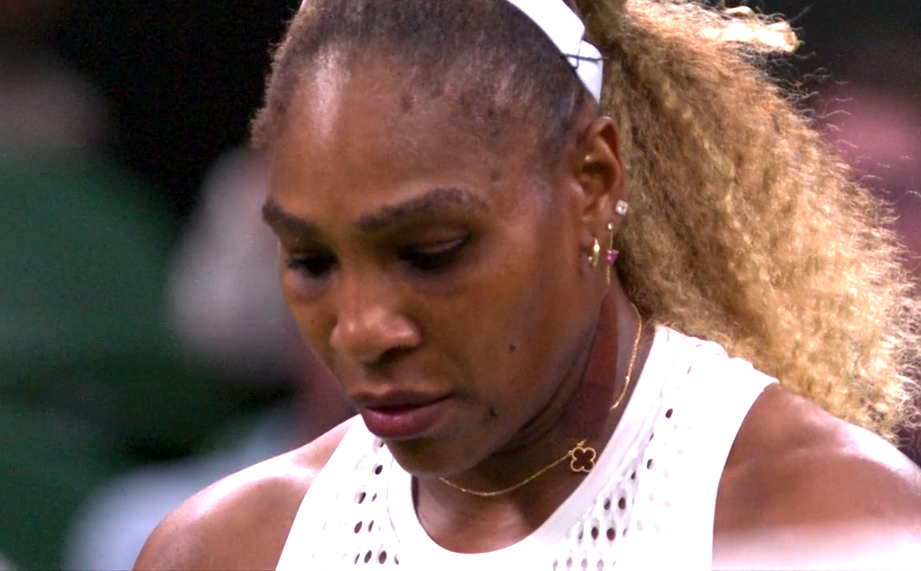
The words are Shakespeare’s, but the sentiment belonged firmly to Serena Williams on Tuesday night, at least from the perspective of an adoring Centre Court crowd. They were there to witness the second coming of a sporting legend and, hanging on her every move, they got what they came for.
Some may have feared that Williams, 44 years old and playing her first singles match since 2022, might suffer a mauling at the hands of Maya Joint, an opponent who was not even born when the American won the first half dozen of her 23 grand slam singles titles. They needn’t have worried; Serena Williams was unmistakably Serena Williams.
The aura of old remained intact, and may even have been magnified by her lengthy absence. Her serve, once the most feared shot in the women’s game, was as silken as ever – and, once she had worked through the gears, barely less destructive in its force and accuracy. Williams can still crush a groundstroke with the best of them, certainly when the ball is in her wheelhouse, and neither has time diminished the mental intensity that made her the finest competitor of her generation.
Whatever has been lost over the past four years – a period in which she has welcomed a second daughter into the world, devoted more time to her business interests and become a figurehead for the efficacy of GLP-1 weight-loss medications – Williams remains a formidable competitor.
How the second coming of Serena Williams gathered momentum
Understandably, it took time for her to rouse herself, to shake off the rust of competitive inertia. Yet the mentality of a champion is the last thing to go. Williams demonstrated as much when she stood within a point of a straight-sets defeat. Had she folded in that instant, had she failed to meet the moment with the spirit of old, few would have blamed her. She had produced a decent performance. She had kept things close and made a match of it.
But that is not the kind of thinking that wins you seven Wimbledon titles, and Williams’ refusal to go quietly offered an emphatic response to the myopic minority who questioned whether she was worthy of a place in the draw.
As she threw down two big serves, the second an unreturnable 122mph delivery that brought up a set point of her own, it was hard to believe this was the same woman who only a few months ago posted a video of herself serving for the first time since February 2023. And as Williams won the next point, patiently outrallying Joint to level the match – who said she couldn’t run? – her reaction spoke of expectation rather than serendipity. There was no bellicose explosion of emotion, no roaring or histrionics. Instead, a silent raised fist acknowledged a job well done, while an impassive expression signalled that more work remained.
Criticism of Serena Williams’s return – and why it was misplaced
For some, though, all that mattered was her inability to complete the task. Williams’ 6-3, 6-7 (6-8), 6-3 defeat merely confirmed what these well-informed knew all along: that the sport has moved on in her absence. That the rank and file now wield just as much power as Williams from the baseline, and will no longer be intimidated by her game. That she has lost half a step, either struggling to get into the corners or failing to summon her former weight of shot once there. A few went even further. Williams’s decision to return to the competitive fray on one of the sport’s biggest stages without playing a warm-up event was an insult to the tournament, it was said; as such, she got what she deserved. So the arguments ran.
Such analysis vastly underplays the difficulty of competing on a grass court, let alone an indoor grass court. A closed roof locks in humidity, making a naturally slick surface even slippier. Players can compensate to some degree by getting lower to the court, but the quick starts and rapid changes of direction required at elite level inevitably become more challenging. Hard courts, however, are another matter. There, Williams would almost certainly be quicker. Only she knows where her journey will take her next but, should she choose to play at the US Open, there will be a sturdier basis on which to judge the quality of her movement.
Either way, it should be acknowledged that the law of diminishing returns kicks in mercilessly after 40. Some balls are simply no longer worth running for. It is hard for a player at any level to accept that reality, let alone one of WIlliams’s stature. Who wants to play the role of bystander as balls you would once have chased down with ease instead sail past? It is a blow to the ego, an unwanted reminder of your own mortality, both sporting and otherwise. And yet it is a necessary art, one where the skill lies in being selective, in shepherding your resources, in saving the greatest effort for the moments of greatest need.
That is precisely what Williams did when presented with the opportunity to level the match, hanging tough to come out on the right side of a 13-stroke rally. Would moments like that would have been made simpler by playing a warm-up event? Undoubtedly. There is no substitute for match play, where adrenaline and nerves come into play, and physical commitment is at the maximum. But as Williams explained in her pre-tournament press briefing, she remained unsure about whether to accept a wildcard right up to the eve of the qualifying competition, a deadline beyond which the decision would have been taken out of her hands.
Why Serena Williams deserved her place in the draw
She was permitted that luxury because she is a seven-time Wimbledon champion and one of the greatest players in tennis history. That status was earned, not conferred. To view her participation simply through the prism of the £80,000 cheque that might otherwise have gone to Katie Volynets, the American world No 101 who was next on the entry list, seems pedantic, reductive and self-righteous.
It also ignores the restorative effect the victory might have for Joint, a fine young player who has been ranked as high as 28th but has struggled for form this year. Coming into the fortnight, the 20-year-old had lost all but one of her previous 13 matches. Now she has one of the most significant victories of her career, a result that will forever remain a personal reference point. Not everyone can say they have beaten Serena Williams at Wimbledon. How do you put a price on that?
As for the All England Club, commercial reality was always going to outweigh other considerations. Even in retirement, Williams remains one of the biggest names in world sport. Her comeback was one of the most significant stories of the year, generating huge buzz around the tournament. It would have been madness to deny her a wildcard. No doubt Volynets was disappointed to miss out, but the disappointment of millions of tennis fans worldwide would have been far greater had it been the other way around.
As it is, the woman who evolved away from the sport four years ago has now revolved back. Not as a perfect recreation of her peak self – because that would be impossible – and seemingly with more humble objectives, if her insistence that she just wants to “have fun” and enjoy the sport from a new perspective is to be believed.
“I don’t need to win, I’ve won more than most people in their whole lives,” Williams said last month at Queen’s Club, where her doubles partnership with Victoria Mboko lasted just one match before the Canadian suffered an injury.
“That is not important to me, and it’s important I keep reminding myself of that. I don’t have anything to prove, I don’t have anything to lose. Everything here is to gain.”
It may be a while before we learn what Williams has gained so far, given that she did not speak to the media following her defeat. What we do know is that the interregnum is over. For how long, who knows? In many ways, the uncertainty is part of the fun.
Serena Williams may not be able to recall time past but, as her brief singles adventure in SW19 showed, she can still have plenty of impact on time present.