
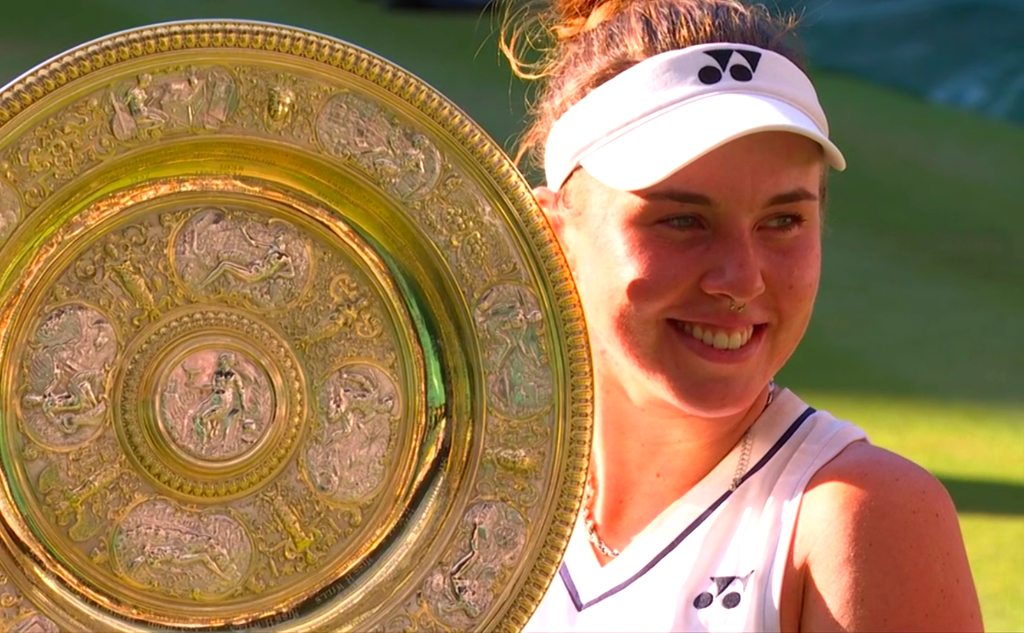
There was always a quiet composure about Linda Noskova. Her mother, Ivana, used to say she inherited her calmness from her father.
“Linda is unflappable,” Ivana once explained. “She has this temperament from my husband. I think this trait is a big part of her success. She just doesn’t care. Whether it’s break point or match point, she’s always calm. It’s not that it doesn’t matter to her, but she can detach herself from it.”
On Saturday at the All England Club, the 21-year-old Czech demonstrated the truth of those words.
Facing her compatriot Karolina Muchova in the Wimbledon final, Noskova stormed into an apparently unassailable lead only to suffer a catastrophic second-set collapse as Muchova, belatedly rousing herself, survived five championship points to force a deciding set.
It was a devastating blow for Noskova, one that inevitably recalled the Centre Court implosion against Steffi Graf that left Jana Novtona weeping on the shoulder of the Duchess of Kent in 1993. But she would not allow her title challenge to be defined by it. Instead, remarkably, Noskova calmly regrouped to crown an afternoon of high drama and high emotion with a 6-2, 5-7, 6-3 victory that earned her a first grand slam title.
The one sadness was that her mother, who died from cancer two summers ago, was not there to witness it. Afterwards, as Noskova thanked her watching father, Drahoš Nosek, together with the rest of her family and team, Noskova ensured she was not forgotten.
“There is also one more person I would like to thank, which is my mum,” said the Czech, her voice trembling. “I definitely would not be standing here without her, so thank you.”
‘Sad years, happy years, sweat’: what shaped Linda Noskova’s Wimbledon win
After blowing a kiss skywards, Noskova briefly reflected on “all the sad years, all the happy years, all the sweat and blood put into this”. It was a nod not only to her own dedication, but also to the sacrifices made by her parents as they strove to foster her talent on limited resources. To the years when the family was split asunder as Noskova’s ambitions took her from the bucolic village of Bystřička, where she grew up, to the city of Prerov, an hour’s drive away, where her mother cleaned offices to make ends meet while Drahoš remained at home, where he worked for a railway firm.
“It was all worth it,” reflected Noskova.
That much is undeniable. Noskova becomes the third Czech champion in four seasons, following the victories of Marketa Vondrousova in 2023 and Barbora Krejcikova a year later. She is also the youngest winner since 2011, when Petra Kvitova defeated Maria Sharapova. Both were on hand to witness the occasion from the Royal Box, where nine-time champion Martina Navratilova was also among the usual glittering array of luminaries.
The scrutiny could not have been more intense and, for the first half of what would be, at two hours and 28 minutes, the third longest women’s final in history, Noskova met the challenge head on. Her serve, the destructive fulcrum of her run to the final, was once again near-flawless. Noskova navigated the opening set without facing a break point, dropping just a single point behind her first delivery, while her smooth power and impressive movement allowed her to dictate the baseline exchanges. In the rare moments she wasn’t exceptional, Noskova was rock solid.
How Karolina Muchova struggled in her second major final
The same could not be said for Muchova. It is widely acknowledged that, on her day, the 29-year-old has the tools to defeat any player in the world. Here, however, she struggled to find her range in the face of Noskova’s excellence. By the time she did, the cause was all but lost. In that sense, Muchova’s second grand slam final mirrored her first, at the 2023 French Open, where she fell behind by a set and a break against Iga Swiatek only to force a decider after her game belatedly clicked into gear.
You would have got long odds on history repeating itself with Noskova leading 6-2, 5-2. Muchova had struggled throughout to summon the free-swinging power on her forehand that got her over the line from match point down against Coco Gauff in the semi-finals (a feat of escapism she also performed against Aryna Sabalenka at the same stage of her final run at Roland Garros, curiously) and as she served to stay in the contest, that wing once again faltered.
Muchova twice survived after netting forehands to present Noskova with championship point; by the time she saved a third with a beautifully executed drop shot, the mental and emotional shackles were visibly starting to loosen. Her serve was gathering force. She was moving with newfound freedom. The variety and creativity that make her so dangerous were finally starting to flow. At the other end of the court, the opposite was happening.
“It was very tough for me,” Noskova later reflected. “My hand kind of froze at certain moments. My feet were not as quick as they had been before.”
‘That’s insane’: Linda Noskova’s battle to remain in the second set
Up to then, moments of peril had been rare for Noskova – and when they came, she had been ready. Facing her first break points of the afternoon early in the second set, she snuffed out the danger with bold, decisive serving. As Muchova threatened to prolong the contest, she did so again. Noskova had already fended off two break points by the time Muchova nailed a glorious backhand winner to bring up a third. The younger woman responded with a thumping 112mph ace; then, when an error gifted Muchova a fourth opportunity, she produced another.
“That’s insane,” mouthed the watching Navratilova.
Not so insane that Noskova couldn’t do it again, sending down an untouchable 114mph delivery to complete a stunning triptych of aces. Indeed, it was not until Muchova’s seventh break point that Noskova finally yielded, sending a forehand wide. By then, a double fault had cost her a fourth championship point, and a fifth would go begging in the next game. It was a torrid sequence for Noskova, one that would culminate with the loss of five straight games. Coming from a woman who normally wears the mask of impassivity so lightly, the anguished cry she emitted as the set slipped away spoke volumes.
So too did the manner in which she put her fingers over her ears as Centre Court rose to acclaim Muchova’s fightback. Yet, if Noskova’s impulse was to block out the reality of the moment, moments later she would be confronted by it in the most palpable form. As she retreated for a bathroom break, the Czech was greeted by the sight of the Venus Rosewater dish, the trophy awarded to the champion. Beside it sat the more modest silver plate awarded to the beaten finalist. Noskova’s resolve hardened.
Linda Noskova: ‘I’m going to leave my soul on court’
“The first step I took off court, the trophies were there,” said Noskova. “I was looking at the big one. I was like, ‘I’m taking this one, no matter what. I’m going to leave my soul on court.’”
If Noskova was replenished, Muchova was depleted. It had taken a monumental effort to restore parity. The momentum was hers but, after an exacting semi-final win over Gauff, did she have the physical and emotional reserves to capitalise?
“I think I started really slow,” Muchova reflected. “On the other hand, Linda started really strong, really good serving games. She played really fast. I was kind of looking for myself. It took a lot of power and strength out of me, I would say, to get back in that second set. I gave it my all.
“The people were cheering on me; I felt it, I felt the support. I felt the momentum in the second set. It was definitely nice that it happened. It took, as I said, some strength out of me.”
As is so often the case in tennis, the opening game of the set was pivotal. Noskova had to stem the tide of games against her. Three break points for Muchova instead threatened to continue the surge. But Noskova held firm and, in the next game, some solid defending earned her a break. The tone was set; she would not be caught.
Noskova: ‘I think she would be proud’
Two years after her mother died on the eve of Wimbledon, Noskova’s victory was punctuated by a palpable sense of catharsis. No two people experience the anniversary of a parent’s death in the same way, but for most it is a time freighted with deep personal significance. So it appears to have been for the Czech, who revealed afterwards that her mother had been on her mind on the eve of the final. As a final service winner confirmed her triumph and she fell to the grass, her body heaving with emotion, those thoughts surfaced anew.
“I had a moment yesterday night when I was thinking about her,” said Noskova. “Sadly, she passed away two years ago, at the beginning of the tournament. So just to be sitting here and looking at the title two years later, it was a big moment for me. But I think she would be proud. I think I made her happy today.”