
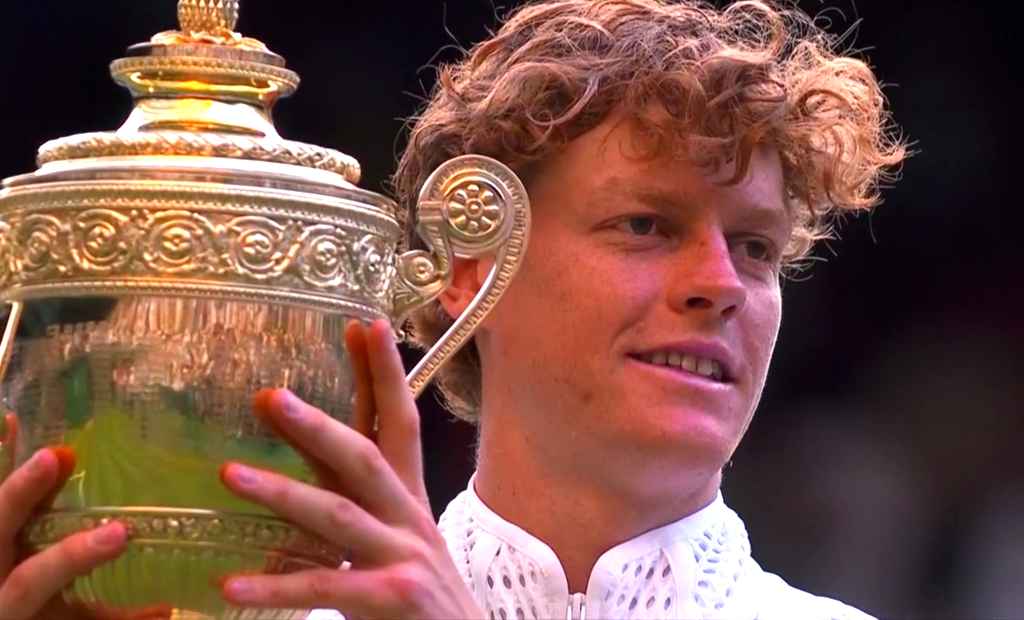
With his second straight Wimbledon crown, Jannik Sinner crossed the velvet rope into one of the most exclusive clubs in tennis.
Before the 24-year-old Italian arrived at the All England Club a fortnight ago, only nine men had mounted a successful defence of the singles title in the open era.
Earning a place on the roll call of back-to-back champions would put Sinner among elevated company, alongside Rod Laver, John Newcombe, Bjorn Borg, John McEnroe, Boris Becker, Pete Sampras, Roger Federer, Novak Djokovic and Carlos Alcaraz as one of the finest exponents of grass-court tennis in modern history.
Yet the auspices were mixed for the returning champion.
On a brutally hot day in Paris, a calamitous meltdown from two sets to love and 5-1 up against Argentina’s Juan Manuel Cerúndolo in round two of the French Open had left Sinner smarting. It was his second successive grand slam disappointment of the season, following a semi-final loss to Djokovic at the Australian Open in January that had derailed his bid for a third straight title in Melbourne. Yet those defeats bookended a four-month period in which Sinner was untouchable, compiling a 30-match winning streak that brought five consecutive Masters 1000 titles.
It was impossible to know which version of the Italian would turn up at Wimbledon, but he arrived there facing questions about his form and fitness that would have been unthinkable only a few weeks earlier.
There was pressure, too. Anything less than a successful title defence would have left Sinner in the curious position of being a dominant world No 1 without being the current holder of a major title. That Alcaraz, his chief rival, was absent through injury for a second consecutive grand slam event would only have accentuated the paradox.
Given the circumstances, Sinner could probably have lived without opening his defence against the redoubtable Miomir Kecmanovic, a solid former top-30 player who embodied a quiet but growing belief in the locker room that the top seed could be beaten. That sentiment doubtless hardened when Kecmanovic briefly threatened a seismic upset, taking a two sets to one lead against Sinner before falling in five.
Yet, despite scorching temperatures in south-west London throughout the first week, Sinner did not drop another set en route to the final. Once there, the defending champion delivered the perfect riposte to his doubters, earning his fifth grand slam title with a 6-7 (7-9), 7-6 (7-2), 6-3, 6-4 victory over Alexander Zverev, the German second seed.
The value of variety
After what happened in Paris, it was a tour de force of mental toughness, one that secured Sinner’s place in the modern pantheon of Centre Court greats. He now has a total of 100 match wins at the majors, where he is mopping up titles at the same rate as Djokovic, who likewise had five by the age of 24. Sinner also possesses an 80% win percentage on grass, something few would have predicted at the outset of his professional career, when he lost his first four matches on the surface (six from eight when qualifiers are included).
A late developer who grew up in the Italian Dolomites, Sinner preferred skiing and football to tennis until his early teens. He has undeniably come a long way. But far enough to merit a place at the top table with McEnroe, Federer and company? That is another question.
For all the undeniable excellence of his ball-striking and movement, for all his clinical mastery of the serve and return, the twin pillars of modern grass-court tennis, Sinner’s skillset is markedly different to that of his predecessors. What he does, he does with undeniable brilliance. His baseline game, which combines relentless aggression with virtually impenetrable defence, bears comparison with the best in history. Less apparent, however, is the variety of shot and powers of improvisation evident among other members of Wimbledon’s back-to-back club.
Laver is an obvious counterpoint. Like Sinner, the flame-haired Australian combined immense power off both wings with a destructive serve, weapons he famously deployed to hit his way out of trouble when things got tight. But it was with good reason that Laver was once introduced at WCT Tour events as “the man with the copper hair but a golden touch” – and it was not because he lacked finesse. As one might expect of the only man in history to complete the calendar year grand slam twice, the Queenslander was a complete player, as accomplished at the net as he was from the baseline, as capable of wielding the scalpel as dropping the hammer. For all his efforts to expand his arsenal, Sinner does not yet possess such variety.
It is not an isolated comparison; a similar versatility may be observed among others of Laver’s ilk.
In an era when the lawns of the All England Club played significantly faster, making serve-and-volley tennis de rigueur, Borg reimagined his baseline game to spectacularly successful effect. The enigmatic Swede was neither a naturally dominant server nor a willing volleyer. But each year, he would retreat to the Cumberland Club in north-west London to hone his grass-court skills, eventually arriving in SW19 with a beefed-up delivery that he would gamely follow into the forecourt. Borg’s unrivalled athleticism – and the vagaries of a surface on which even a bad volley would stay low enough to be effective – more than made up for any technical shortcomings. Allied with a peerless return, a teak-tough mentality, and some of the best passing shots the game has ever seen, Borg’s adaptability earned him five straight titles.
So a talent for tailoring style to circumstance, for being able to force things from the net or mix it from the backcourt, has been a hallmark of all the great modern Wimbledon champions, even if some have inclined more towards one approach than another. Becker and Sampras reaped the rewards of their huge serves at the net. Federer and Djokovic won 15 titles between them, predominantly from the back of the court. But champions have a habit of finding a way, and each could do things differently when occasion demanded. Becker could hang with Ivan Lendl from the baseline, just as Sampras could live with Andre Agassi. Federer was a lethal volleyer; Djokovic became one. The one constant has been adaptability.
On Centre Court, then, variety is king. Newcombe, who bowed to no one in his eagerness to get forward, is the only real outlier among the select band to have defended the title. But like fellow net-rusher McEnroe – whom no one could accuse of lacking variety – the broad-shouldered Australian possessed a baseline game predicated on making the most of his attacking skills, particularly on grass. Whether driving a flat forehand into the corner or pinning his opponent back with a deep sliced backhand, Newcombe’s prime objective was to get to the net, where the real business of the match could be conducted.
That is not to say that every successful title defence in the open era has been built on a diet of serve-and-volley, chip-and-charge, crush-and-rush. Such skills are on the endangered list, certainly relative to the days when the likes of Laver, Newcombe and McEnroe held sway. But Federer, Alcaraz and even Djokovic have all, to a greater or lesser degree, kept the tradition alive, if not as a go-to play, then certainly as a tactical weapon, a means to vary the method of attack and keep opponents guessing.
Why Sinner needs Alcaraz
Sinner, too, values diversity.
Since last year’s US Open final, when he bemoaned his “predictability” after Alcaraz relieved him of both his title and the No 1 ranking, he has worked hard to expand his skillset, not least by sharpening his transition play and net game. The Italian nonetheless leans on those dimensions of his game sparingly, largely because Plan A is so good that other options only become essential when he is facing Alcaraz.
This year’s Wimbledon final underlined the point: of the 275 points Sinner contested against Zverev, just 23 were played in the forecourt, barely half as many as the Italian attempted the previous summer against Alcaraz. In other words, without Alcaraz around, not even Zverev – the second best player in the world – has been able to force Sinner out of his baseline comfort zone.
It might be argued that, having devised a winning formula, he would be mad to deviate from it. As Agassi famously remarked in his autobiography Open, the job is not to be the best in the world 365 days a year, but simply to be better than the guy you’re up against on a particular day. Sinner is out to win, not score marks for artistic impression. If he can ride his natural game all the way to the Wimbledon title, why bother trying something different? Yet as Agassi also observed – and Sinner knows all too well – “great things begin at the end of the comfort zone”. If and when Alcaraz returns with his wrist in fully functioning order, Sinner will need more.
Every great champion needs a foil, a player whose presence on the other side of the net drives them to the highest expression of their talent. McEnroe found that opponent in Borg. Stefan Edberg had Becker, whom he faced in three straight Wimbledon finals, winning twice. Rafael Nadal had Federer, who beat him to the title twice but could not quite do it a third time.
The common thread in each of those historic rivalries was how the protagonists brought out the best in one another. So it is with Sinner and Alcaraz. The Spaniard has twice denied Sinner match points at a major before going on to win the title, first in an electrifying late-night quarter-final at the 2022 US Open, and then in last summer’s epic Roland Garros decider. Each time, Sinner came back stronger, never more so than when he wrested the Wimbledon crown from Alcaraz last summer.
As is the way of it, that loss in turn prompted Alcaraz to redouble his focus and intensity. By the time he faced Sinner again, a few weeks later at the US Open, he was ready, rolling past his rival in four sets. Cue another turnaround by the Italian, who went on to defeat Alcaraz in the title round at the season-ending ATP Finals, before claiming his seventh win in 17 meetings between the pair in April’s Monte Carlo final.
Such back-and-forth is the lifeblood of all great sporting rivalries; in its absence, Sinner has for the most part been clinically efficient, but rarely inspired. His results have done the talking. With his title win in Rome, for instance, he became the only player other than Djokovic to complete a full house of Masters 1000 titles, a feat he achieved a full seven years earlier than the Serb. As things stand, his status as the world’s best player is indisputable – and yet, beyond Alcaraz, who is capable of forcing him to produce his very best tennis?
Not Zverev, it would seem. Despite the excellence he showed in taking advantage of a depleted field to land his first grand slam title in Paris, and the conviction with which he advanced beyond the fourth round of Wimbledon for the first time, the German went into the final on the back of nine straight defeats against Sinner. His unfettered jubilation at taking the first set hardly spoke of a deep-seated belief that he could win two more, and so it proved, Sinner rebounding to win a match that, though high on technical excellence, offered little by way of spectacle and stardust.
The numbers told the story. Sinner dominated every meaningful metric, winning 80% of points on his first serve to Zverev’s 72%, and 65% on his second to 59%. He also hit more winners (58 to 49), made significantly fewer unforced errors (25 to 45), and won a higher proportion of points at the net, despite venturing forward less often.
But for all the technical proficiency on show, the match itself was a dud, certainly in comparison with the extraordinary drama and emotion delivered by the women’s final between Linda Noskova and Karolina Muchova. A contest in which the first break point does not arrive for almost three hours is unlikely to keep an audience on the edge of their seats. Instead, the final felt like a throwback to the 90s, when big serves held sway, and the artistry and imagination of previous eras seemed irredeemably lost.
And as the thunderbolts were hurled, and Sinner once again asserted his superiority over an opponent he had mauled in just 58 minutes a few weeks earlier in Madrid, the nagging sense that only Alcaraz could truly test him grew ever stronger.
Do any of these quibbles matter? Sinner and his fanbase can point to two straight Wimbledon titles and say not. But if the Italian’s presence in the back-to-back club feels incongruous, it is partly because his game lacks the completeness of the modern grass-court greats. He is, undeniably, a wonderful, multi-surface player, a multiple major winner and dominant world No 1 whose place in the tennis Hall of Fame is already assured. But we can admit all that and still acknowledge that his grass-court game does not yet possess the multitudes of a McEnroe or Federer.
At 24, there is ample scope for that to change. Even Djokovic, whose game Sinner’s most closely resembles, needed time to evolve into a player for all seasons.
Nor should it be overlooked that, while Sinner already belongs to an elite group of multiple major winners, his body of work does not yet have the depth of most of his peers in Wimbledon’s back-to-back club. Five of the nine men who have successfully defended the title in the open era are in double figures for grand slams won. Of the remaining four, Newcombe, McEnroe and Becker have 31 major singles finals between them, while Alcaraz, like Sinner, remains a work in progress (albeit one with a career grand slam to his name). Sinner is not yet the player that, all things being equal, he is on course to become; for now, the scale of his achievements outstrips the rate of his development.
Yet that can only bode well. A second straight Wimbledon title is merely the latest piece of evidence to suggest that Sinner’s best years are ahead of him. For now, though, he is a champion cast in a different mould to his predecessors.